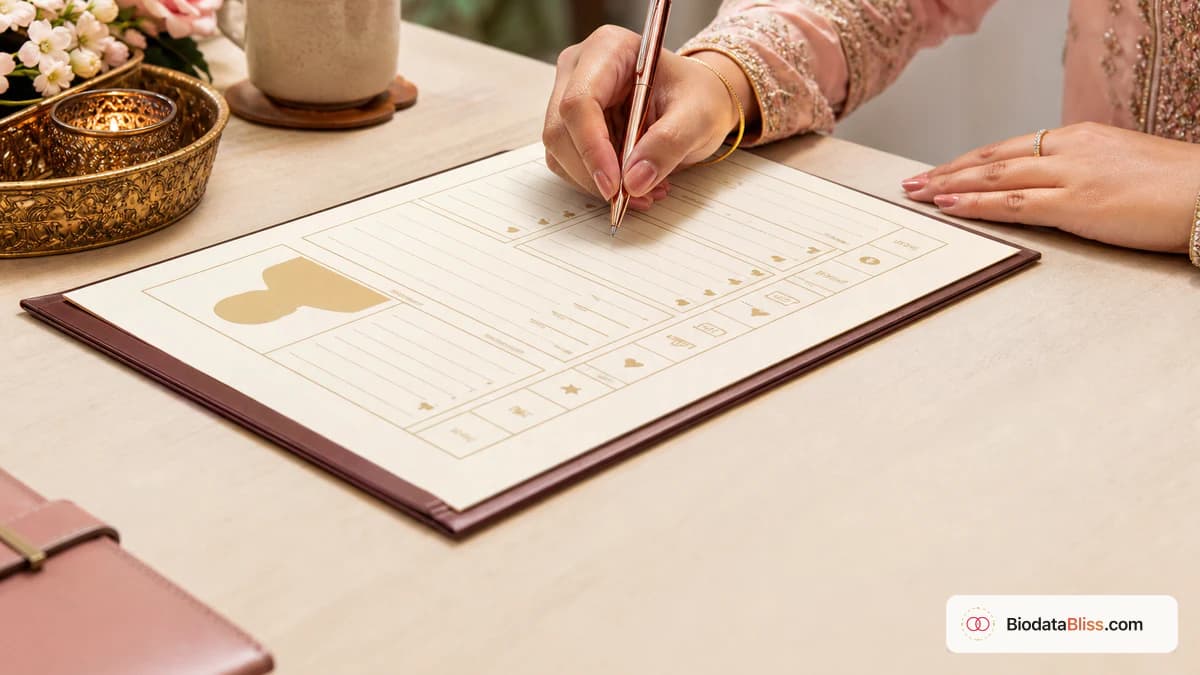
The best partner preferences do one thing well: they show what kind of life you hope to build, without putting anyone down. Families remember respectful tone more than perfect wording.
The partner preferences section is an optional block on your marriage biodata PDF. Many people either keep it too vague or write rigid lines that sound like demands. Neither helps. When families read a biodata document, they look for clarity and maturity: what matters to you, what you are flexible about, and how respectfully you express both. This guide helps you write partner preferences that feel human, realistic, and easy to trust — then download them as part of your print-ready PDF on BiodataBliss.
What this section is really for
Partner preferences are not a checklist to eliminate people aggressively. They are a short optional note on your biodata PDF so your document states preferences clearly. Think of this as a polite direction, not a list of rejections.
Families often read this section right after education and family background. If it sounds balanced, they continue the conversation. If it sounds dismissive, they move on even when your biodata is otherwise strong.
- Use 4 to 7 short lines, not a long paragraph
- Focus on compatibility, not superiority
- State what matters most: city, values, profession, life goals
- Keep expectations aligned with your own profile and family context
- Write in a tone you would be comfortable saying in front of elders
Start with age, height, and location politely
These are usually the first filters families apply. The easiest way to sound reasonable is to use ranges and flexibility instead of strict cutoffs.
Location preferences are especially important today because many family introductions involve relocation, hybrid work, or long-distance sharing. A single clear line here prevents confusion later.
- Good: "Prefer partner aged 27-31; flexible by 1 year when values align."
- Good: "Height preference around 5'5" to 5'10"; open to nearby range."
- Good: "Prefer Bengaluru, Hyderabad, or willingness to relocate after marriage."
- Avoid: "Only exact age and exact height."
- Avoid: "No out-of-city candidates."
Education and profession: be clear, not elitist
When writing education and profession preferences, specificity helps. But avoid prestige-heavy language that sounds insulting to good candidates from different backgrounds.
A better approach is to mention qualification level, broad profession categories, and mindset fit. This keeps the section practical and respectful.
- Good: "Prefer graduate/postgraduate partner with stable career goals."
- Good: "Open to IT, healthcare, government, teaching, or family business profiles."
- Good: "Value responsibility and long-term commitment over job title alone."
- Avoid: "Only top-tier institutions accepted."
- Avoid: "No private job" or other blanket dismissals
How working women can phrase expectations confidently
For many working women, this section is where they need to communicate support for career continuity. A calm, direct line works best.
You do not need to sound defensive. You also do not need to over-explain. One or two mature lines about work-after-marriage expectations create clarity and reduce avoidable mismatch.
- Good: "Prefer a partner supportive of a working spouse and shared responsibilities."
- Good: "Open to relocation with mutual career discussion."
- Good: "Looking for a respectful, partnership-based marriage."
- Avoid: apology-driven lines like "I hope job is not an issue"
- Avoid: confrontational language or ultimatum-style wording
Community, religion, and lifestyle lines
If your family uses community, religion, horoscope, or dietary lines in biodata, keep them factual and brief. This is not the place for strong opinions or broad judgments.
Lifestyle preferences like vegetarian household, language comfort, or family values can be very useful when stated neutrally.
- Good: "Prefer vegetarian partner / family as per home practices."
- Good: "Community preference as per family tradition."
- Good: "Language comfort: Hindi and English; regional language welcome."
- Avoid: negative labels about communities or professions
- Avoid: long ideological statements in preference bullets
If your family does not usually include community or horoscope lines, you can skip them. Clarity is better than unnecessary fields.
What to never include in partner preferences
Some lines create immediate trust issues and should not appear in a marriage biodata. Harsh demands, appearance shaming, dowry signals, and copied portal listing text are common examples.
Remember, this section is read by parents and relatives before they know you personally. Tone is interpreted as character.
- No insults, sarcasm, or all-caps demands
- No colorism or body-shaming lines
- No financial conditions framed as entitlement
- No copy-pasted generic text from random templates
- No rushed lines written in frustration
A practical formula you can reuse
If you are unsure where to begin, use this simple order: age/location, education/profession, lifestyle/family values, and flexibility line.
This structure keeps the section balanced and readable, especially for mobile-first readers on WhatsApp.
- Line 1: Age and broad location preference
- Line 2: Education and career preference
- Line 3: Lifestyle or family-value compatibility
- Line 4: Flexibility statement
- Line 5 (optional): Community/horoscope note as per family norms
Final review before sharing
Read your preference lines aloud with a parent, sibling, or trusted elder. If any line sounds harsh in speech, rewrite it before sharing.
On BiodataBliss, preview your partner preferences beside your education, family, and photo sections. You can immediately see whether the page feels balanced or too rigid.
- Keep each line short and natural
- Prefer ranges over absolute limits
- Use hopeful wording instead of rejection wording
- Check readability on phone screen
- Share final PDF, not screenshot captures
Final tip
Write partner preferences the way you would introduce your expectations in a respectful family conversation: clear, realistic, and kind. Add them in the BiodataBliss form, preview your full marriage biodata, and download when every line feels balanced.
Start on Create Biodata, then compare designs on Templates before checkout.
Ready to write better partner preferences? Fill your biodata, preview how the section reads, and download when it sounds right.
Start your biodatahttps://biodatabliss.com/create-biodata (opens in a new tab)